The Blue Above Chandni
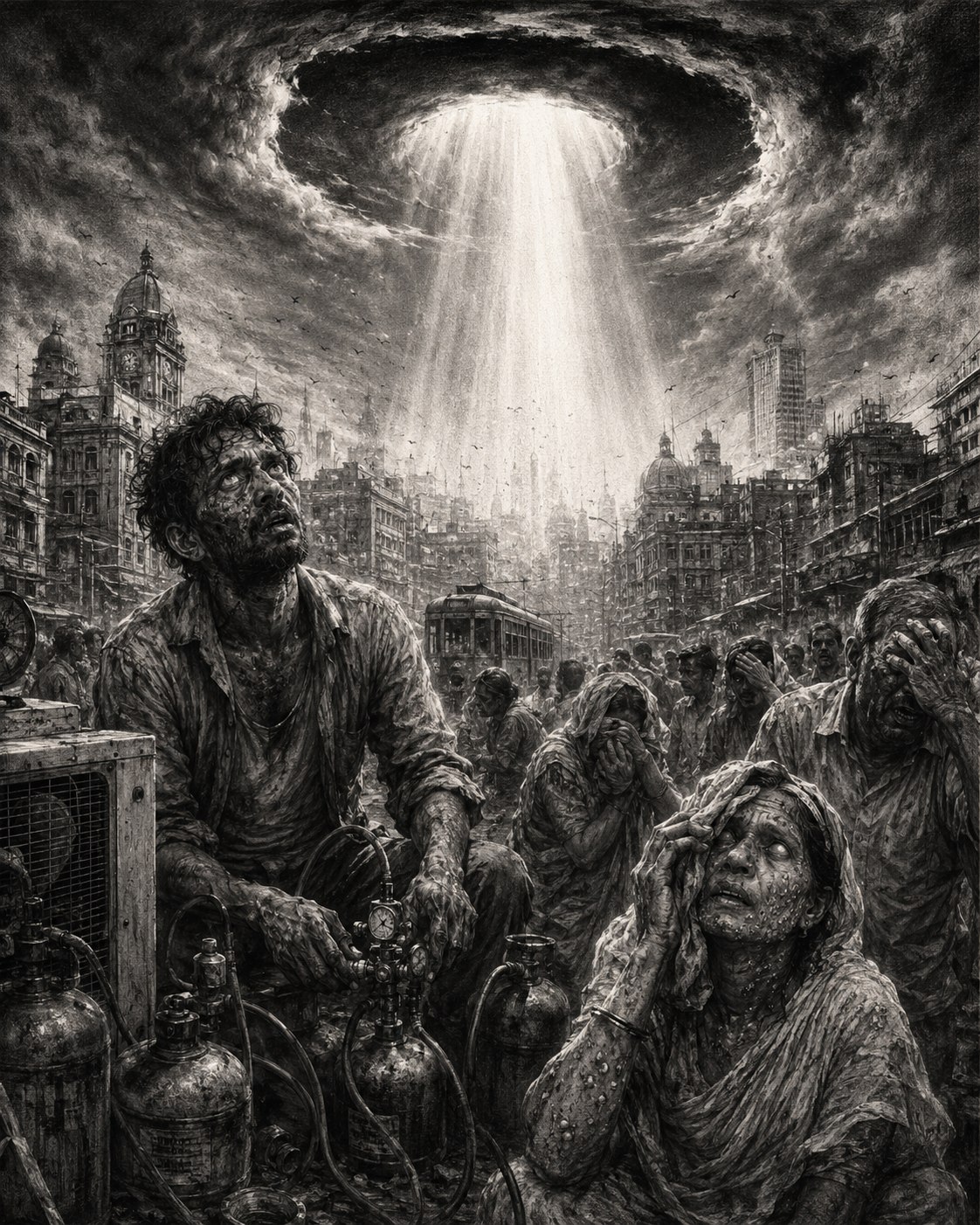
THIS IS A WORK OF FICTION
By half past ten, Chandni Chowk had already begun to shine like a punishment.
The sun stood above the tangled tram wires and signboards with the intimate malice of a creditor. It picked out the chrome on fan shops, the tin roofs of tea stalls, the backs of men bent under impossible bundles, the small greasy puddles outside electrical spare-parts shops where wires, switches, fuses, imported nonsense, and counterfeit certainty were sold by the fistful. Buses coughed near Chowringhee. A taxi with one surviving door handle leaned into traffic like an old wrestler. Somewhere a tea boy shouted for change, somewhere a man in a helmet argued that a Chinese capacitor could not possibly be Chinese if it had already failed, and above all this, the city’s immense domestic quarrel with itself went on as usual.
In the lane beside Madan Street, under a board that said NEW MODERN OPTICALS in peeling blue letters, Nirmal Dutta held a cracked pair of bifocals up to the light and saw a milky moon floating in the right lens.
“Not the lens,” he said.
The customer, a retired school clerk with a gamchha around his neck, blinked at him. His eyes had the dull shine of boiled fish.
“What do you mean, not the lens?”
“I mean your glass is scratched, yes, but that cloud is in your eye.”
The man received this information with the offended dignity of someone whose body had misplaced an item and was trying to blame him for it.
“My eye was fine last month.”
“Last month Bengal was also promised rain,” Nirmal said. “Many things are announced.”
The clerk did not laugh. Customers rarely laughed when Nirmal was accurate. Accuracy in Calcutta was acceptable only when directed at cricket averages, exam marks, and other people’s sons.
Outside, the day brightened further, though there was no room for it to do so. A white tourist couple passed toward Esplanade wearing hats wide enough to shade a small municipality. The woman’s nose was pasted with a stripe of cream. The man carried a water bottle and looked at the city with the mild terror of someone who had paid in advance.
From the footpath, Haru the air-conditioner mechanic watched them.
He was a thin man in his late forties with a face browned and folded by heat, and a moustache that seemed to have been applied with a tired brush. He wore a faded shirt printed with little blue checks and carried a tool bag made from an old fertiliser sack. Haru repaired AC units in the market, cinema offices, cheap hotels near Sudder Street, and sometimes the new apartments where people spoke of “comfort” as if it were a moral achievement.
He also came to Nirmal once a month to tighten the screw on a pair of old spectacles he never changed.
“Again cataract?” Haru asked, nodding toward the clerk.
“Everyone has become eighty years old suddenly,” Nirmal said.
Haru smiled at that. It was not a large smile. It had the careful economy of a match struck in wind.
“Sun is strong.”
“Sun has always been strong.”
“Maybe now it is personal.”
Nirmal looked up at him. “Sun does not have time for us, Haru.”
“That is what you think.”
The clerk interrupted. “How much for new glasses?”
“Glasses won’t fix this. You need a doctor.”
“Doctor means money.”
“Yes,” Nirmal said, and because he was not cruel he looked away first.
He had inherited the shop from his father, along with a brass trial-frame, a wall calendar from 1998, and the family talent for remaining solvent by insulting nobody too much. His father had measured eyes with ritual patience. Nirmal measured them with the same patience and less faith. His wife, Mitali, said he had become a widower before she died because grief had entered him early and rented the best room.
Mitali had died five years ago, not dramatically, not with music, but in the ordinary bureaucratic manner of the middle class: bills, tests, opinions, queues, relatives advising, savings dissolving, a final invoice arriving with absurd punctuality. Since then, Nirmal had wanted only three things: to keep the shop open, to sleep four hours without waking, and to avoid remembering that on the day she first complained of a headache, he had told her not to be dramatic.
At noon, a crow fell from the ledge above the transformer shop.
It did not flap. It dropped like a burnt glove and landed beside a basket of coil wires. For a second everyone stared. Then a boy selling lime water picked it up by one wing and flung it into the drain with the efficient disgust of poverty.
“Heatstroke,” said someone.
“Poison,” said someone else.
“China,” said the capacitor man, broadly.
By Thursday, three more crows had fallen, a street dog near the metro stairs had developed raw patches along its back, and Nirmal had counted nineteen customers complaining of glare, halos, burning eyes, sudden blurring. The old, the poor, the hawkers, the traffic police, the schoolchildren whose parents could not afford tinted lenses. A bus conductor came in with both eyes red and weeping, joking that if he went blind at least he would not have to see passengers pretending they had already paid.
Nirmal gave him dark glasses at cost.
“You are becoming philanthropist now?” asked Bappa, who ran the tea stall beside the shop and regarded generosity as a disease that could spread if not mocked.
“Put it on my bill.”
“Your bill is already writing its autobiography.”
“Then add a tragic chapter.”
Bappa poured tea into a glass and lowered his voice. “People are saying strange thing.”
“People always say strange thing. It is our state bird.”
“No, really. Yesterday a man from Dharamtala said his nephew got burns on his neck just walking to office. Ten minutes only.”
“That can happen.”
“In December?”
Nirmal looked at him.
It was not December. It was late March. But Bappa’s error lodged somewhere.
That afternoon, a woman from a gated tower off Park Street came in with a child whose cheeks were blistered in a pattern like lace. The mother wore sunglasses indoors and spoke in English first, then Bengali, then a flat exhausted mixture of both.
“He was in the school courtyard for assembly. Only fifteen minutes. They said vitamin D is good. Now see.”
Nirmal saw. He also saw, with a small sour pinch, that the child had been brought in a car with tinted windows and still had suffered less than the barefoot girl outside selling pens. Calcutta had many equality projects. Rainwater did not respect class. Mosquitoes were democratic except when they were not. Now the sun too had entered public service, though like all public service it seemed to reach the poor first and longest.
He sent them to an eye hospital, then phoned his niece Raka.
Raka taught atmospheric chemistry at a college in Salt Lake, which meant family members expected her to explain weather, pollution, mould, bad hair days, and why refrigerators smelled of betrayal.
“Dadu’s shop has become a cataract factory,” Nirmal said when she answered.
“I have class.”
“You always have class. That is the problem with education.”
“What happened?”
He told her.
She did not laugh. That worried him. Raka laughed at nearly everything, especially uncles.
“Are the cases mostly from your area?”
“Chandni, Esplanade, Chowringhee side. Some Park Street. Why?”
“Any chemical smell?”
“This is Chandni. Chemical smell is civic identity.”
“No, sweet smell. Like old refrigerant, solvent, something metallic?”
Nirmal thought of Haru’s tool bag, the faint cold stink that sometimes entered before him.
“I don’t know.”
“I’ll come tomorrow morning,” Raka said. “Don’t stand outside too much.”
“At my age, if I stand inside also I am outside.”
“Wear dark glasses.”
“My whole life is dark glasses.”
“Very poetic. Also stupid. Wear them.”
The next morning the sky had changed.
It was still blue, but not the dusty, exhausted, tram-ticket blue of Calcutta. It was a harder blue, polished and deep, like enamel on an expensive vase. Buildings looked overexposed. Shadows had sharp edges. Faces seemed peeled of softness. Even the paan stains on the pavement shone with unnatural clarity.
Raka arrived wearing a cotton kurta, a wide-brimmed hat bought in Darjeeling, and the expression of someone whose scientific curiosity had just been mugged by fear.
She stood outside the shop and lifted a small handheld UV meter from her bag.
“Where did you get that?” Nirmal asked.
“Department.”
“You stole it?”
“Borrowed without paperwork. A noble tradition.”
The machine beeped. Raka looked at the reading and went still.
“What?”
“This is wrong.”
“Wrong like meter wrong, or wrong like world wrong?”
She moved two steps into the lane, then back. She took another reading. Then another.
“Ultraviolet is absurdly high here.”
“Because of pollution?”
“Pollution usually blocks some UV. This is like…” She stopped.
“Like?”
“Like something has thinned the ozone overhead. Locally.”
Nirmal waited.
“That is impossible,” she said.
“In this city, impossible must take a token and wait.”
Raka did not smile.
They spent the next two hours walking under awnings and balconies, taking readings like thieves measuring a house before robbery. The numbers rose near the AC repair godowns, behind old hotels, near the rooftops where cooling units rattled day and night like mechanical lungs. The highest reading came from the narrow passage behind the defunct Globe cinema, where rusted compressors, copper coils, cracked outdoor units, and dead refrigerators lay stacked under a blue tarpaulin.
Haru was there.
He was squatting beside a cylinder, tightening a valve. Around him stood a dozen old refrigerant canisters, their paint flaking, their labels half rubbed off: R-11, R-12, R-22, names from an older chemical kingdom.
“Haru,” Nirmal said.
The mechanic looked up slowly. His eyes behind the thick spectacles seemed cloudy at the edges.
“You came to buy AC?”
“To ask why you are sitting inside a museum of banned gas.”
Haru touched the cylinder with tenderness. “Not banned. Forgotten. People throw away. I collect.”
Raka stepped forward. “Where did you get these?”
“From where rich people throw things. Hotels, offices, old houses. Everybody wants new machine. Old machine goes to Haru.”
“What do you do with the gas?”
He smiled again, that match-in-wind smile.
“Gas becomes air.”
Raka’s face tightened. “How much have you released?”
Haru shrugged. “Little little. Years. Night-time. Rooftop, drains, empty lots. City breathes so much poison already. One more breath, who will notice?”
Nirmal felt a coldness in him that had nothing to do with refrigerant.
“Why?”
Haru stood. He was not a tall man, but anger gave him borrowed height.
“You remember the American woman?”
Nirmal did not.
“Of course. For you people, poor man insult is like tea steam. Gone. For me it stays.”
“What woman?”
“Seven years ago. Outside your shop. Summer. She came from hotel. AC not working. Hotel manager called me. I was carrying cylinder. I bumped her bag. She shouted. Said, ‘Don’t touch me.’ Like I was drain water. Like my hand had disease.”
He looked toward Chowringhee where tourists moved through the heat under umbrellas, hats, creams, and the protection of currencies that opened doors.
“She said sorry later perhaps,” Nirmal said weakly.
“She laughed with her husband. Took photo of street children. Gave one biscuit packet. Very kind madam.”
Raka said, “So you poisoned the air?”
“I opened the sky,” Haru said.
The sentence hung there.
Raka stared at him, not as one stares at a criminal, but at a calculation that has walked into the room wearing sandals.
“You don’t understand what you’ve done.”
“I understood enough. White skin burns. They come here and look at us like we are scenery with smell. I made sun look back.”
Nirmal said softly, “Haru, UV does not check passport.”
The mechanic blinked.
“Everyone is burning.”
“Foreigners first.”
“No. Hawkers first. Children first. Men standing all day first. People who cannot buy sunscreen first. People like us.”
Haru’s mouth worked. For a moment he looked merely old, not dangerous. Then his face closed.
“You are trying to make me fool.”
“You needed no help,” Raka said.
It was the wrong thing to say.
Haru lunged for the cylinder, not toward them but away, dragging it by its hose. Raka shouted. Nirmal, who had once thought grief had emptied him of speed, moved faster than he had in years. He caught the hose with both hands. Haru shoved him. The cylinder toppled, struck a rusted compressor, and the valve snapped.
A white plume burst out with a shriek.
The smell was sweet, cold, ancient. It filled the passage like the breath of a dead refrigerator. Raka grabbed Nirmal’s arm and pulled him back. Haru tried to close the valve, coughing, half blind, his fingers slipping on frost.
“Leave it!” Raka shouted.
But he would not. Perhaps in that second he saw not gas but purpose escaping, years of insult, labour, cracked knuckles, unpaid bills, hotel managers calling him “Haru-da” when they needed him and “that fellow” when they did not. He hugged the cylinder and twisted the broken metal with a rag.
The plume slowed.
Then Haru sat down beside it and began to laugh.
It was not a villain’s laugh. Nirmal had seen enough cinema posters to know the difference. It was the laugh of a man who had spent his whole life building a staircase and had reached the top to find it led into a wall.
Police came. Then municipal officers. Then men from departments whose shirts were cleaner than their authority. They photographed cylinders, sealed the godown, argued over jurisdiction, and advised the public to avoid unnecessary sun exposure, an instruction received across the city with the enthusiasm usually reserved for being told to avoid breathing.
News spread faster than caution. Chandni became famous for a week. Reporters arrived with makeup melting under studio lights. One called it “the Chowringhee Ozone Terror.” Another stood in front of Nirmal’s shop and asked whether Calcutta was now unsafe for foreigners. Behind her, Bappa served tea to a traffic constable whose eyelids had swollen nearly shut.
“Foreigners?” Bappa muttered. “Excellent. We are only garnish.”
Haru was taken to a government hospital under police guard. Raka gave statements. Nirmal’s shop filled daily with people wanting black glasses, UV glasses, cheap glasses, anything between them and the new blue cruelty overhead. Supply failed. Prices rose. Respectable men who had once negotiated ten rupees off a lens now whispered, “Best quality, please,” with the fear of people discovering that their eyes were not upper middle class.
Three weeks later, a pre-monsoon storm arrived from nowhere.
The sky darkened over Maidan, rolled toward Esplanade, and broke with a violence that made buses pause and stray dogs reconsider atheism. Rain hammered tin, glass, tarpaulin, helmet, skull. The city steamed. Drains backed up. Hawkers lifted goods onto crates. Men laughed because they were wet and alive and because in Calcutta rain gives everyone permission to become temporarily foolish.
Raka came to the shop drenched, carrying an envelope.
“Preliminary report,” she said.
“Will I understand?”
“No.”
“Then say it wrongly but use small words.”
She sat on the stool Mitali used to occupy and spread the pages on the counter.
“Haru’s releases contributed. No doubt. Years of old CFCs and other refrigerants from multiple sites. But the pattern is strange. The thinning was already beginning before his main releases.”
Nirmal frowned. “Before the insult?”
“Before he started collecting heavily. Maybe long leakage from old cold-storage units, illegal servicing, dumped cylinders, industrial solvents. The whole market has been breathing out banned chemistry for years. Haru made it worse. Focused it. But he didn’t create it alone.”
“So the city helped.”
“The city always helps,” Raka said.
Rainwater ran down the glass front of the shop, turning the street into a shaking painting.
“There is more,” she said.
Nirmal looked at her.
“The highest old readings in the archived satellite anomalies are not from behind Globe. They’re from your building.”
“My building?”
“This lane. This exact block.”
He laughed once. “My shop sells spectacles, not sky damage.”
“What was here before your father’s shop?”
“A repair warehouse. Radios, fans, maybe refrigeration parts. Before my time.”
“Below?”
“Storage. Locked for years. Landlord has key.”
Raka did not speak.
Nirmal felt the old floor under his sandals, the wooden counter, the wall calendar from 1998, the brass trial-frame, his father’s careful hands, Mitali’s stool. He remembered a smell from childhood, sweet and cold, always strongest in summer when the shutters were down. His father saying, “Old machinery smell, nothing,” and opening the shop early to let it out. He remembered Mitali, newly married, teasing him that his family business smelled like ice without water.
That evening the landlord opened the basement.
The stairs were narrow, damp, and furred with grey mould. At the bottom lay what the city had hidden because hiding was cheaper than removing: cracked cylinders, rotted hoses, compressor shells, metal drums with labels eaten by time, and, in a corner under a collapsed shelf, a dozen pale blue canisters marked with a foreign company’s name and a warning no one had obeyed.
One had been leaking for years.
The hiss was so soft it was almost polite.
Nirmal stood there with the torch shaking in his hand. The beam moved over dust, rust, old gas, old neglect. Not a plot. Not revenge. Not even hatred. Just storage. The great Indian philosophy of putting danger in a back room until it either solved itself or became someone else’s department.
On the top canister, someone had scratched initials into the paint.
H.D.
Nirmal bent closer, and below the initials, nearly hidden by corrosion, saw another mark: N.D.
His father’s hand. His father’s stock. His father’s silence.
For a moment the basement held all of them: Haru with his grudge, the tourist with her disgust, Mitali laughing at the cold smell, his father unlocking the shutters, customers blinking into a brightness they had not earned, a city bargaining with poison because proper disposal cost money.
Later, when they brought Haru from the hospital to identify the cylinders, he wore dark glasses and bandages on both hands. His face had blistered and peeled. He looked at the initials and then at Nirmal.
“You knew?” he whispered.
Nirmal could have said no. It would have been true in the way most truths are useful: narrow, polished, incomplete.
Instead he said, “We all knew a smell.”
Above them, through the grating at pavement level, the rain stopped. A blade of sunlight entered the basement, thin and blue and exact. Everyone stepped back from it at once.